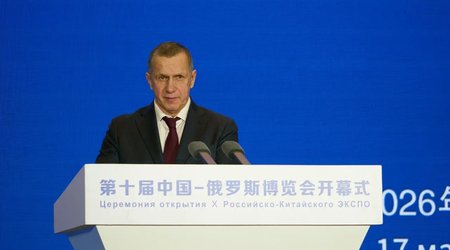
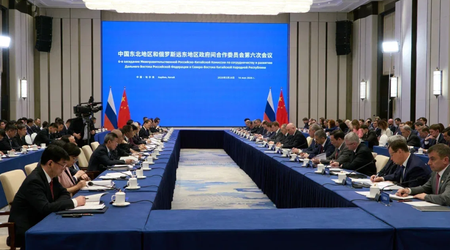
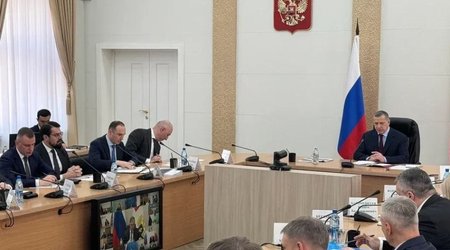
On April 23–24, the Trans-Baikal Territory hosted the foreign economic forum “New Horizons - 2026” - a visiting event of the Eastern Economic Forum

Representatives of the Ministry of Transport of the Russian Federation, the State Duma, educational institutions, regional authorities, foreign business and the diplomatic corps discussed the role of the Trans-Baikal Territory as a strategically significant region for large-scale joint projects of Russia, China and Mongolia.
The main topics for dialogue at the Forum were: the tourism sector of the region in the context of an integral part of the region’s economy, expansion of cooperation in the energy sector, mining industry, development of transport, logistics and digital infrastructure.
The key event of the Forum was the plenary session “New Horizons of Strategic Partnership of Russia, China and Mongolia.”
The plenary session was attended by Director of the Department of Information and Press of the Ministry of Foreign Affairs of the Russian Federation Maria Zakharova, Chairman of the State Duma Committee of the Federal Assembly of the Russian Federation for the Development of the Far East and the Arctic Nikolai Kharitonov, Governor of the Trans-Baikal Territory Alexander Osipov,Governor of the Irkutsk Region Igor Kobzev, Deputy Minister of Transport of the Russian Federation Valentin Ivanov, Trade Representative of the Russian Federation inMongolia Maxim Vasiliev, Minister of Industry, Trade and Investment of the Republic of BuryatiaDenis Garmaev,Head of the Trans-Baikal Railway - a branch of JSC Russian RailwaysVladimir Antonets,Head of the Department of Logistics and Exhibition Economics, Xi'an International University (PRC) XuDehun, Director of the Polytechnic College of the Erdene Tuv aimag of Mongolia Otgonkhuu Sharkhuu, Chairman of the Party Council of the Erdenes Mongol company Buyambua Myagmarzhargal, Consul General of the Islamic Republic of Iran in KazanMirzakhani Davud.
As the governor of the Trans-Baikal Territory noted, the region plays a huge role in the newly emerging world, in relations between China and Russia, contributing to ensuring the sustainability of both economies.He also noted that today it is clearly visible how the centuries-old rules that regulated trade, humanitarian exchanges and security issues are fundamentally changing and almost completely being abolished, and the role of the United States and Europe in these changes.Particular attention was paid to international relations.
“In the changing picture of the world, the relationship between Russia and China, as well as Mongolia and our other allies, is of fundamental importance.Now about 70% of our total trade turnover passes through the Trans-Baikal Territory, so our region is of strategic importance,” noted Alexander Osipov.
Director of the Department of Information and Press of the Ministry of Foreign Affairs of the Russian Federation, Maria Zakharova, emphasized that over the years of its existence, the Forum has become an effective platform for developing specific solutions aimed at the prosperity of the regions, and also emphasized the importance of friendly relations between countries in the conditions of the formation of a multipolar world.
“Today, when world politics and economics are going through serious transformations, the contours of a future multipolar world are being formed in Eurasia.And a key role in this process belongs to the development of relations between Russia and the states of the region.This cooperation becomes the pillar of Eurasian integration.Our country has historically attached particular importance to contacts with its closest neighbors.Based on a strong foundation of cultural exchange and mutual respect, we are building truly long-term and trusting relationships that serve as the basis for common prosperity,” -saidMaria Zakharova.
Consul General of the Islamic Republic of Iran in Kazan Mirzakhani Dawood noted that the Forum provides a valuable opportunity to exchange views on the prospects for cooperation.
“Today the world is experiencing a period of deep and multifaceted instability, which is not limited to the sphere of politics and security, but seriously threatens the global economy.From tariff wars and cross-border sanctions to financial pressure and the desire to impose political will through the economy, the US unilateralism demonstrates that the economy has also become one of the main arenas for the exercise of power in the international system.The result of this process is the growth of mistrust and violations in global trade, as well as the imposition of increasing costs on peoples and governments,” the consul noted.
“In this situation, the role of BRICS, the SCO and the Eurasian mechanisms is becoming increasingly important.These institutions should rapidly strengthen financial, banking, trade, infrastructure, strategic cooperation and play a more active role in the formation of new economic and monetary relations and make a significant contribution to the development of multilateral cooperation,” added Mirzakhani Dawood.
Separately, emphasis was placed on the role of the Trans-Baikal Territory as astrategic transport and logistics hub.Head of the Department of Logistics and Exhibition Economics at Xi'an International University (PRC), Xu Dehong, emphasized the importance of the role of the Trans-Baikal Territory for the development of logistics between countries.
“China has maintained Russia’s status as a major trade and economic partner for 15 years, cooperation in the field of logistics hubs, multimodal transport, and logistics is strengthening, and we can create an effective, safe, sustainable supply chain in Eurasia.We hope that we will cooperate very effectively with the Trans-Baikal Territory in this area,” noted Xu Dehong.
During the plenary session, First Deputy Director of the Roscongress Foundation, Director of the Eastern Economic Forum Igor Pavlov noted that as a consequence of the actions of the United States, which have already had a significant impact on the world economy, China will look for new opportunities to create pockets of effective demand abroad.
“By creating pockets of effective demand abroad, the Chinese economy will inevitably move some of its production abroad, including to the most promising nearby areas, and this will be the Russian Far East.Therefore, all companies, organizations, government bodies that take part in organizing interaction between Russia, China, Mongolia and other countries need to feel and understand that in the near future the growth of this process will be like an avalanche,” noted Igor Pavlov.
More than 500 representatives of government, business, and foreign departments took part in “New Horizons.”
The forum is organized by the government of the Trans-Baikal Territory together with the Roscongress Foundation with the support of the Russian Ministry of Foreign Affairs, the Russian Ministry of Eastern Development, the Russian Ministry of Transport and the Russian Ministry of Natural Resources, the Trans-Baikal Territory Development Corporation and the Trans-Baikal Territory Tourism Agency.
The Trans-Baikal Foreign Economic Forum “New Horizons” served as a visiting platform for the Eastern Economic Forum (EEF) for the fourth time.
XI Eastern Economic Forum will be held from September 1 to 4, 2026 in Vladivostok.The EEF is organized by the Roscongress Foundation with the support of the Government of the Russian Federation.
Source: https://75.ru/news/442630